Introduction
Using artificial intelligence tools in legal practice is no longer a novelty—it is part of daily work. However, the quality of the results you get depends directly on how you phrase your instructions and questions.
Artificial intelligence does not act as an “autonomous legal adviser,” but as a digital collaborator that requires clarity, completeness, and sound guidance—much like a new associate at a law firm.
This guide aims to provide a practical, immediately usable framework so that every lawyer can use the dikaio.ai platform effectively, safely, and productively.
1. The core principle: clarity and structure in the prompt
To use the dikaio.ai platform effectively, every question should be structured around three elements:
[Action] + [Subject matter] + [Context]
- Action: A specific instruction to the platform on what to do (e.g. draft, analyse, explain, compare)
- Subject matter: The legal issue, object, or document that is the focus of the question (e.g. parental responsibility, works contract, damages claim)
- Context: The legal parameters, methodology, or sources on which the answer should be based (e.g. under the Civil Code, recent case law, a particular procedural stage)
The platform uses a consistent legal style. What matters is not only how the output reads, but how you use it.
Example of a vague formulation
“What applies to parental responsibility and social media?”
Example of a sound formulation
“Analyse whether parental responsibility can be limited or removed when one parent systematically posts the child’s personal data on social networks without the other parent’s consent, with reference to the applicable legal framework and relevant case law.”
Important note: The more specific the instruction, the more usable the answer.
2. Drafting legal documents
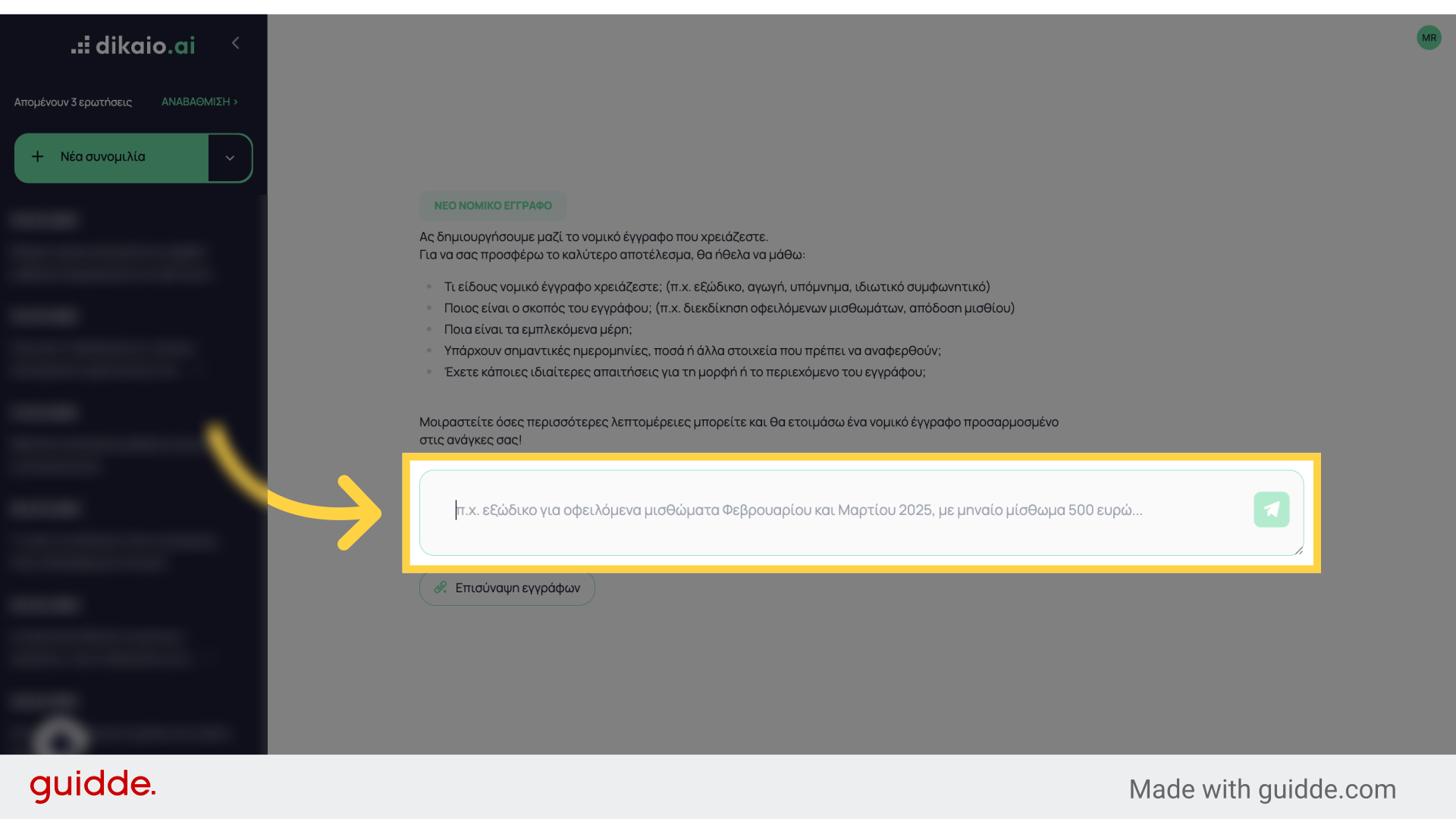
dikaio.ai can produce complete, high-quality legal documents provided it receives the necessary factual information.
2.1 Essential elements for contracts
When requesting a contract, you should typically include:
- Type of contract (e.g. services, lease, cooperation)
- Parties (full identification details, etc.)
- Term
- Financial terms (amounts, method and timing of payment)
- Special clauses such as confidentiality / termination / liquidated damages (where required)
Example of a vague formulation:
“Draft a services agreement.”
Example of a sound formulation:
“Draft a services agreement between company {company name}, with its seat in Athens, and {name / trade name of counterparty}, with its seat in Thessaloniki, for the provision of digital marketing services. The term should be 12 months and the fee €2,000 per month, payable at the end of each month. Include in particular:
– a confidentiality clause
– termination terms with 30 days’ notice
– force majeure
– a limitation of liability clause
– governing law and jurisdiction”
Important note: The more factual detail you provide (parties, amounts, term, terms), the fuller and more immediately usable the document.
2.2 Extrajudicial notices, claims, and other legal documents
For procedural documents, accuracy of facts and completeness of information are decisive.
When framing your request, specify in particular:
- Type of document (e.g. extrajudicial notice, statement of claim, application)
- Subject / legal basis (e.g. debt recovery, termination of contract, damages)
- Parties (basic identification details)
- Facts (a concise but clear statement of what happened)
- Financial details (amounts, calculations, relevant periods)
- Critical deadlines or required steps (e.g. payment deadline, notice, withdrawal)
Example of a vague formulation:
“Draft an extrajudicial about rent.”
Example of a sound formulation:
“Draft an extrajudicial demand for payment of outstanding rent from landlord {name} to tenant {name}, for property at {address}. The debt is €2,400, corresponding to three unpaid monthly rents for January to March 2026. Demand full payment within 10 days of service and include an express reservation of all lawful rights.”
Important note: The more complete the factual data, the more immediately usable the generated document.
3. Common mistakes and how to avoid them
3.1 Vagueness
- ⚠️ “Extrajudicial notice”
- ✓ “Draft an extrajudicial for €600 in unpaid rent for two months, with payment due within 5 days.”
Important note: Generic questions produce generic answers.
3.2 Insufficient context
- ⚠️ “Look at the file”
- ✓ “In the attached document, identify the termination clauses and assess whether a penalty clause is provided.”
Important note: The platform does not guess—it works from the information you give it.
3.3 Multiple questions in one instruction
- ⚠️ “Tell me about GDPR, also draft an extrajudicial, and explain minors”
- ✓ One clear question per message
Important note: Each question should address one specific legal issue.
3.4 Unrelated topics in the same conversation
- ⚠️ Leases, GDPR, and criminal law in one thread
- ✓ A separate conversation for each matter
Important note: The conversation works as a “case file”—do not mix unrelated topics.
3.5 Combining different actions in one prompt
- ⚠️ “Analyse the contract, translate it, and write a summary”
- ✓ Split actions into successive requests: Analysis → Translation → Summary
Important note: One action per request yields more accurate output.
3.6 Not selecting or using sources
- ⚠️ A question with no reference to relevant sources or case materials
- ✓ Explicit reference or selection of relevant documents / sources
Important note: When sources are available, using them materially improves accuracy.
3.7 Excessive or unfocused use of sources
- ⚠️ Selecting many irrelevant documents or sources (e.g. an entire library or multiple folders with little connection to the question)
- ⚠️ Sources that do not relate to the specific legal issue (e.g. irrelevant case law or EU legislation)
- ✓ Select only substantially relevant sources and documents
- ✓ Targeted use of legislation or case law according to what the question requires
Important note: Source selection must be directly relevant to the question. Indiscriminate or excessive material does not improve quality and may cause confusion or inaccuracy.
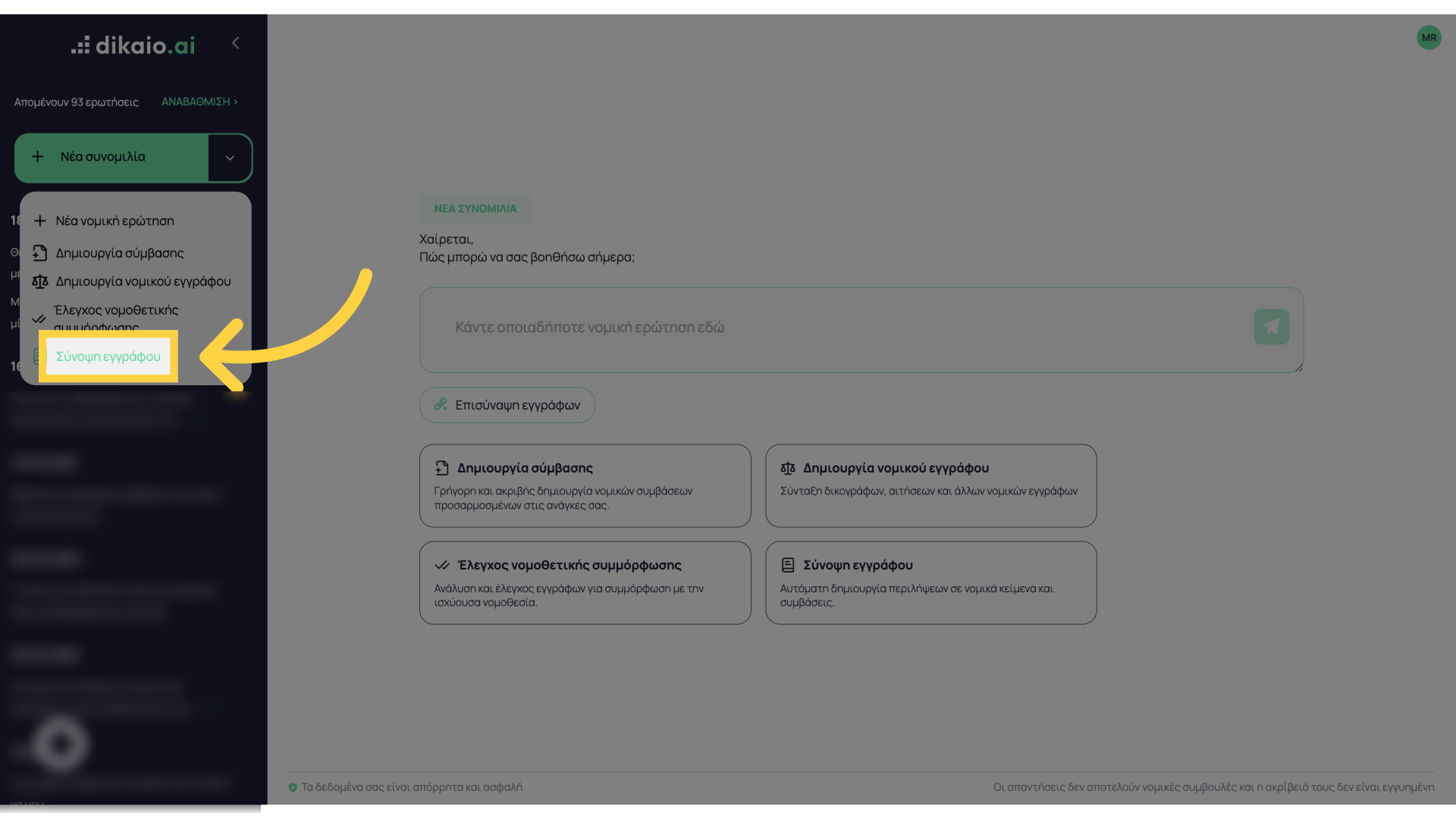
3.8 Unclear instruction as to the desired output
- ⚠️ “Translation”
- ⚠️ If several documents are attached (e.g. three files), a generic request like “Summarise” may process all of them regardless of your real intent.
- ✓ “Translate the text into English, preserving legal terminology.”
- ✓ Identify the document explicitly (e.g. “Summarise the document ‘Contract of sale’”) or narrow the selected documents beforehand, deselecting those that are not relevant.
Important note: Without a clear desired output, answers tend to be generic and less usable.
3.9 Omitting basic facts
- ⚠️ “Draft a damages claim”
- ✓ Include: parties, amounts, facts, dates
Important note: The platform does not invent facts—it uses what you provide.
3.10 Not using conversational continuity
- ⚠️ Restarting from scratch for a small fix
- ✓ “Add a clause…”, “Simplify the text…”, “Shorten…”
Important note: Answers improve step by step; you do not need to restart.
Most mistakes are not caused by the platform itself, but by how the request is framed. Clarity, completeness, and focus are the main drivers of reliable, legally usable results.
4. Using legal sources (Legislation & case law)
dikaio.ai allows you to use legal sources such as Greek and EU legislation and relevant case law. Correct, focused use materially improves accuracy, substantiation, and practical value.
When you formulate your question, you should:
- Select appropriate sources from the “Sources” area on the right of the chat before submitting (e.g. Greek legislation, Greek case law, EU legislation, EU case law)
- Specify the sources you want (e.g. particular provisions or relevant case law)
- Direct the analysis to the appropriate legal framework (e.g. Civil Code, administrative law, EU law)
5. The importance of dialogue
Effective use of AI relies on successive, evolving interaction. The best answer does not require a perfect first prompt; it emerges through ongoing refinement and more specific instructions.
When using dikaio.ai, use follow-up instructions to refine and steer the answer.
Examples of refinement prompts
- “Identify possible legal gaps or ambiguities”
- “Add relevant case law.”
- “Focus only on fault”
- “Format the text as an extrajudicial statement”
Important note: Treat the platform as a dynamic collaborator, not a one-shot answer machine. Quality improves substantially through successive interaction and targeted guidance.
6. In short
To use dikaio.ai effectively, follow these principles:
- Frame clear, complete, focused requests
- Provide critical case facts (e.g. parties, amounts, dates, material facts)
- Define the desired output clearly
- Improve answers through successive follow-up instructions
- Review and cross-check both the output and the cited sources
Conclusion
Artificial intelligence does not replace the lawyer; it supports thinking, speed, and productivity. Its value depends on how it is used.
Effective use is not merely a technical skill—it reflects sound legal drafting, structured thinking, and clear guidance. The fuller, more specific, and more focused the request, the more reliable and legally usable the result.
dikaio.ai can be a substantive collaborator in legal practice when used with critical judgment, professional care, and awareness of its capabilities and limits.